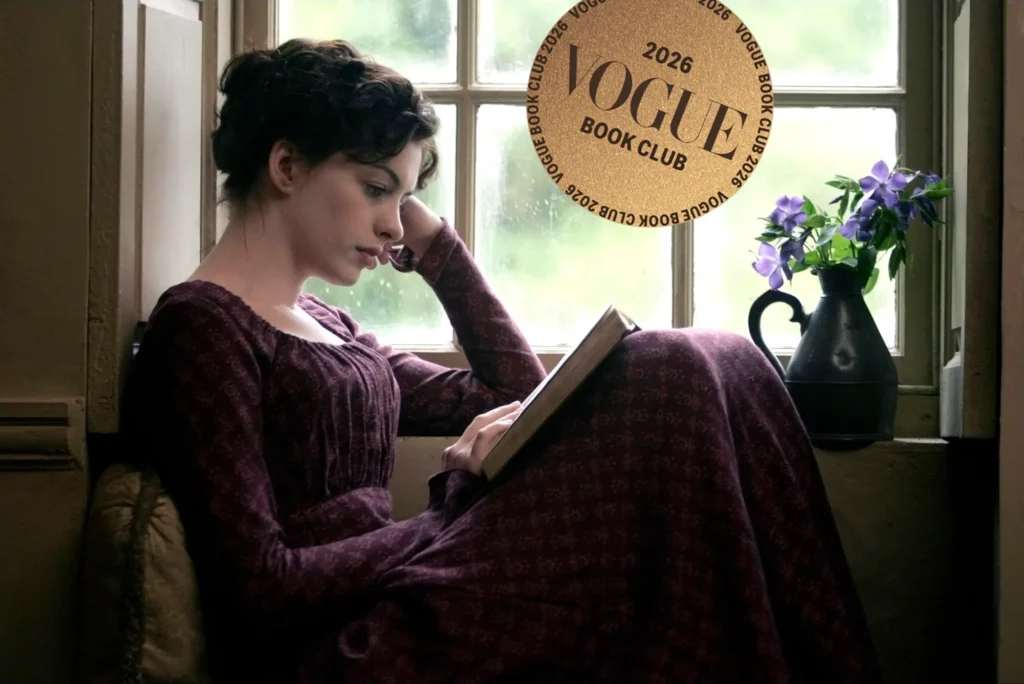
In December, on the occasion of the 250th anniversary of Austen’s birth, Freire spoke to Vogue Spain about Austen’s legacy and the importance of looking beyond the excessive mythologizing and romanticizing that have long shaped both the novelist’s biography and the interpretation of her work. Freire also shared her preferred reading order for Austen’s six major novels—as well as the epistolary work Lady Susan. This is a condensed translation of that interview.

Vogue: Where does your fascination with Jane Austen come from?
Espido Freire: Jane Austen is one of my favorite writers. She isn’t my absolute favorite—that place still belongs to Shakespeare. But in recent years, I’ve been asked to talk about her so often that she has become almost a friend, as well as a writer I return to and look to for inspiration. That is important because Jane Austen is one of the writers who has inspired the biggest fan cultures. There is a group called the Austenites, who not only study her work but also hold gatherings where they recreate aspects of life during the Regency period, particularly in England and the United States. I’m not part of that group, but I do belong to the group of writers who have become interested in Austen and the circumstances of her life. My fascination began at university, when I read Sense and Sensibility, which was the Austen novel we studied.
Related Video
Best Moments From Vogue World 2026 Milan Livestream
That first encounter eventually led to your book Querida Jane, Querida Charlotte. What did you discover as you began to unravel the mythology surrounding Austen?
In that book, I followed the paths of both Jane Austen and the Brontë sisters through England. That was when I first visited the places where Austen had lived, and I began to notice that there was something about her that wasn’t quite the way we had been told. Neither the exaggerated romanticism that we often associate with her novels nor the image of her as a hidden, delicate flower really matched what I was seeing in her life. That trip was more than 20 years ago, and I feel that I understand her mindset and the circumstances of her time better and better. That is very important if we want to pay genuine tribute to her work.
You devote your Alianza essay to precisely this reassessment, questioning some of the more romanticized versions of her life. Why do you argue that her life was less epic and more restricted by strict social and cultural conditions than we often like to believe?
There have been significant shifts in the way Jane Austen’s biography has been presented. The earliest biographies came from within her family. Naturally, they were shaped by how her descendants wanted to portray her, as well as the family environment around her. They also emphasized the influence of whichever branch of the family they themselves belonged to. What is striking is that all these versions agree on her shyness, modesty, and propriety. To understand that, we have to remember that these accounts were written in Victorian England, when the ideal of the “angel in the house”—the woman who was perfect in her discretion and domestic virtue—was at its height. Her nephews genuinely believed they were doing Jane a favor by softening what they saw as her faults.
There was also a completely male perspective at work. Her nieces would have told a different story, but the nieces didn’t write. They simply passed their versions on to the men in the family or offered fragments of letters and private testimony. That is one side of it. The more heroic version of Austen came later, when her novels began to be adapted for the screen and other female writers began reclaiming her as an important figure, even as a feminist reference point—although that label doesn’t really fit her literary work as such.
You also argue that the romantic elements of both her life and her novels have been exaggerated. In what way?
When we read her novels, it is natural to assume that they might be projections of her own life. We tend to think that if someone wrote about something, they must have experienced it themselves. The truth is that, as far as we know, Austen’s romantic life was not as spectacular as we would like to believe—or as we might have wished for her. That makes her imagination, storytelling, and powers of observation even more impressive. She wrote from within the limited space available to respectable women, or “proper young ladies.” We cannot fully understand the behavior of her characters, their conversations, the importance of dancing, or all the gossip unless we understand that these were among the few things women of their social position could aspire to. Through codes that seem almost impossible for us to understand today, people communicated things as important as affection and respect. They could also communicate contempt. Of course, love is important, but what really mattered was property and financial security. For women, property was often transferred through marriage because even inheritances were frequently tied to marriage. So Jane Austen often writes more about personal freedom and poverty than about romance. But it is impossible to separate those subjects completely.
Do you think her lack of a financial dowry was the decisive reason she never married, or were other personal factors more important?
Look, it simply didn’t happen. Marriage just wasn’t in the cards for her. [Laughs.] There were many circumstances. One was that, at the time, there was a significant surplus of women because of the Napoleonic Wars. Jane also had no money. Her father couldn’t provide a dowry for his daughters. But her older sister Cassandra was engaged and would have married if her fiancé hadn’t died of illness. So, certainly, Jane’s lack of a dowry made her less desirable as a potential wife, but other circumstances would have mattered, too. We also have to remember that marriage was not the only role available to women in England at the time. There was, for example, an entire secondary marriage market. Many women died in childbirth, and their relatives—often unmarried women—would step in to take care of the family. Our idea that women fulfill themselves through marriage is completely contemporary. For women at that time, it was a different question. It had a great deal to do with their social role. Unmarried sisters had an important social function, particularly when it came to caregiving and strengthening family networks. At one point, Jane Austen even writes about the physical dangers of marriage, including the risk of dying in childbirth and the premature aging caused by repeated pregnancies and raising children.
Reading your essay, it becomes much easier to understand why, even though it may be painful for modern readers, many of Austen’s characters submit to their social and family obligations.
There was much more of a shared survival mentality within the family and social class than a focus on individual desire. You can feel that in her novels. She writes about major mistakes made by female characters who rush into marriage, marry without love, or marry without respecting themselves. And, of course, the opposite is also true. Sometimes circumstances leave them with no choice but to marry.
On another note, can we say that Jane Austen achieved moderate literary success during her lifetime?
Yes. She didn’t have the overwhelming success of Walter Scott or some of the poets of the time, who enjoyed most of the literary prestige. But her novels began to sell, and she started earning royalties. She earned enough to realize that her dream was within reach—that writing and publishing could actually provide an income. In fact, she received an invitation from the librarian of the Royal Palace on behalf of the Prince Regent because he had enjoyed her work. So, did she become rich? No. Did she earn money? Yes. Did she become much more famous after her death than she had been during her lifetime? Yes. Did she publish under a pseudonym? Yes, but that was common at the time. It was her brother Henry who officially revealed her identity shortly after her death.
What is your ideal order for reading Austen’s novels?
I usually recommend starting with the most accessible books and gradually moving toward the more difficult ones. My order would be Pride and Prejudice (1813), Emma (1815), Sense and Sensibility (1811), Persuasion (1817), Mansfield Park (1814), and Northanger Abbey (1817). I would leave Northanger Abbey for last because it is more unusual. It has a Gothic-parody element, it is very Cervantine, and it may be more difficult to understand.
I wouldn’t leave out Lady Susan either. It is a minor novella, but you have to read it. You can put it in seventh place or read it after Persuasion. You should also read some of her letters and, if possible, some of the books I’ve written about her to make the more difficult aspects easier to understand. Finally, there is a facsimile edition of The History of England, which Austen wrote as a teenager. That one is for serious Austen enthusiasts. But it gives you a glimpse of a very young Jane parodying the way she was taught the history of England’s kings. It shows the talent for humor and intellectual argument that she already had as a child.
Of all the novels, do you have a favorite?
I started reading Jane Austen as a teenager, and now I’m a 50-year-old woman. Your aspirations and your understanding of love change as you get older. They have to change. So you find a different kind of connection in her novels at different stages of life. These days, Persuasion moves me the most. It is a story about second chances, reflecting on your mistakes, and continuing to believe in life.
Is there anything else you would like to add?
Only that I organize trips to places connected with Jane Austen. This year, as always, they will take place in October. Much of what I write is intended not only to help people approach the texts but also to help them connect with these places. With me or without me—it doesn’t matter. But if you have the opportunity to visit that part of England, see it for yourself. Understand what it meant to live in the countryside, in that cold, under that rain, wearing those clothes, with the feeling that your entire day and your entire life had already been planned. And think about how far we have come since then. It’s not that we should stop demanding other rights and freedoms for ourselves and for many other women, but we should appreciate what it means to be a woman in the 21st century, because sometimes we idealize the past without really understanding what we are saying.